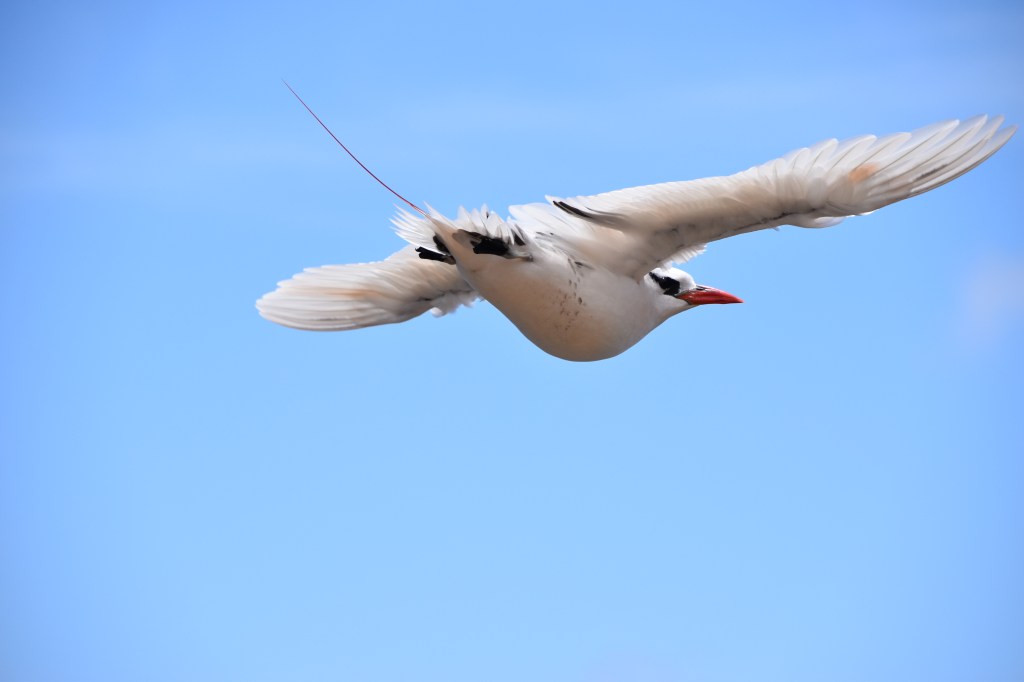
Luke thinks my fascination with tropicbirds is obsessive! What’s there not to love about these magnificent creatures with their elegant colours, plumage and courtship flight? Then of course, tropicbird chicks are also endearing fluff balls that turn into pretty cute bitey chicks!
The Red-tailed Tropicbird (Phaethon rubricauda ssp. roseotincta) is a large seabird weighing nearly a kilogram that nests throughout the Pacific and Indian Oceans. Tropicbirds (Phaethon genus) are the only living members of the Order Phaethoniformes. Through human history, the Red-tailed Tropicbird was prized and admired for its crimson tail feathers which are about a third of a metre long. Maori call this bird “Amokura” and Hawaiin chiefs used the plumes in headresses. The female tropicbirds apparently admire the plumes too. They choose mates with similar length plumes to themselves.
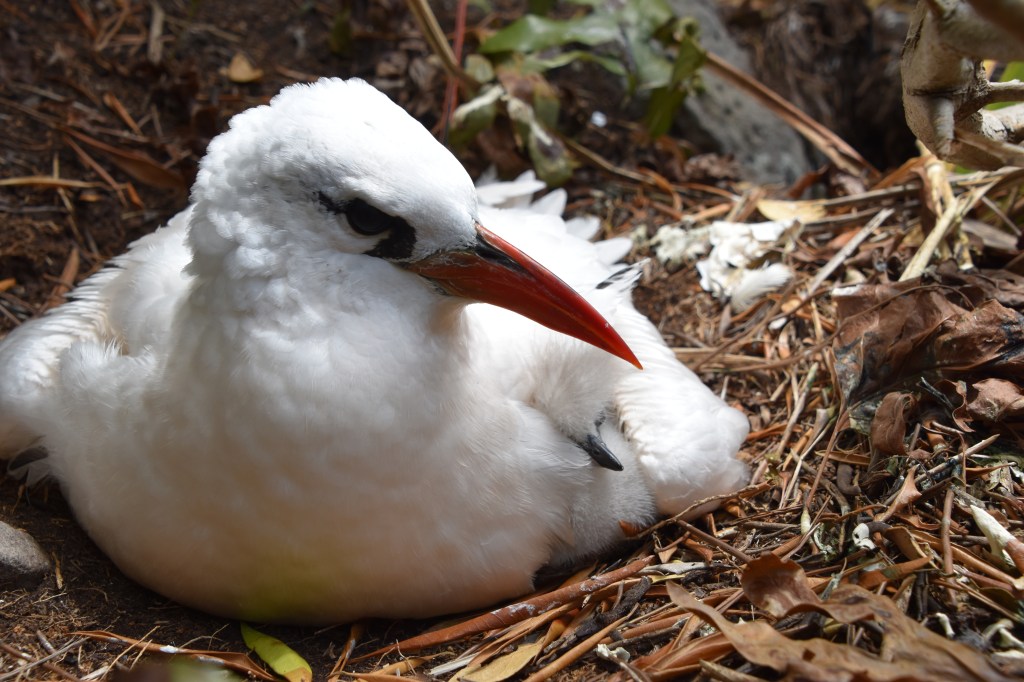
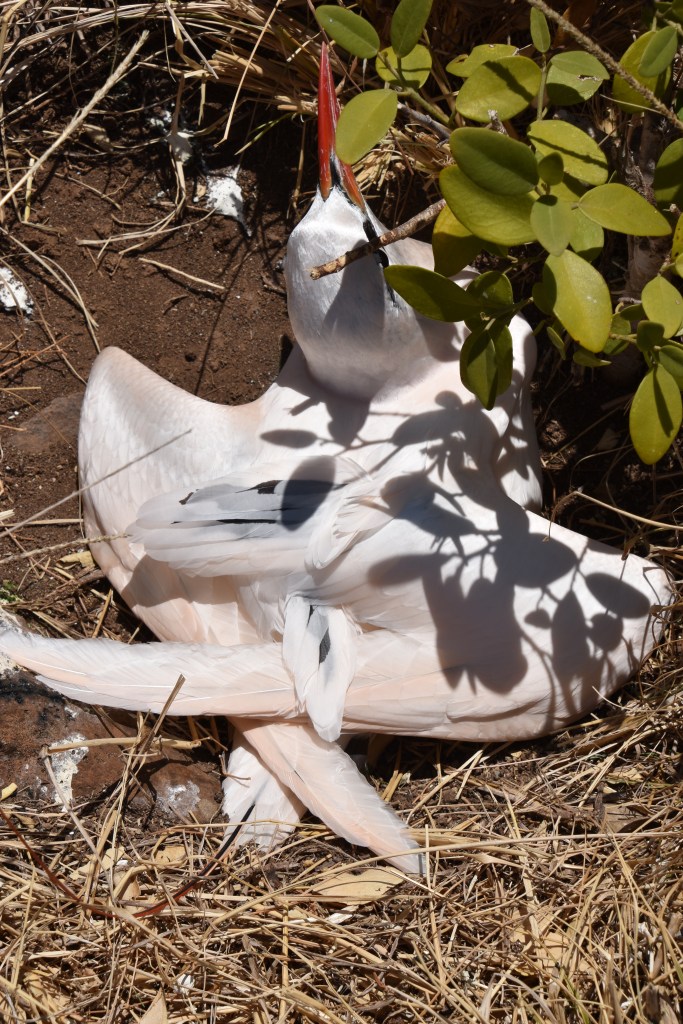
Tropicbird plumage is actually magnificent! The sub-species on Phillip Island, roseotincta is so named due to the slight pinkish hue to its feathers. This hue varies subtlety amongst individual birds. Like the flamingo, the colour value could be a result of the prey they eat. Although the tropicbirds general colour appears whitish, most of the feather bases on their head, back and wings are black. They have a striking black eye mask and a scarlet red bill.
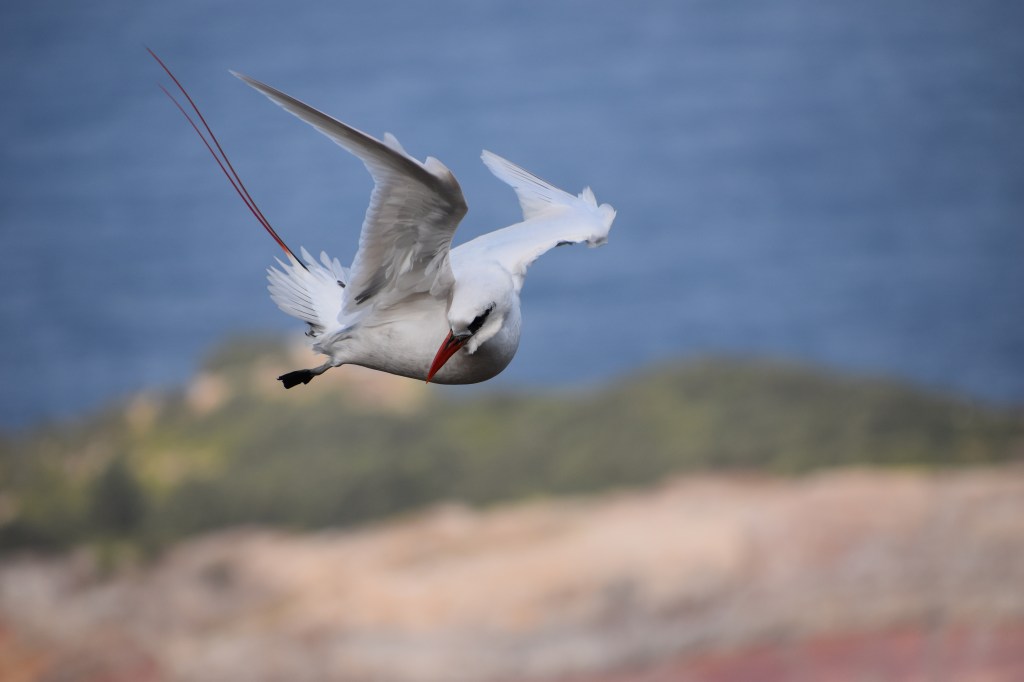
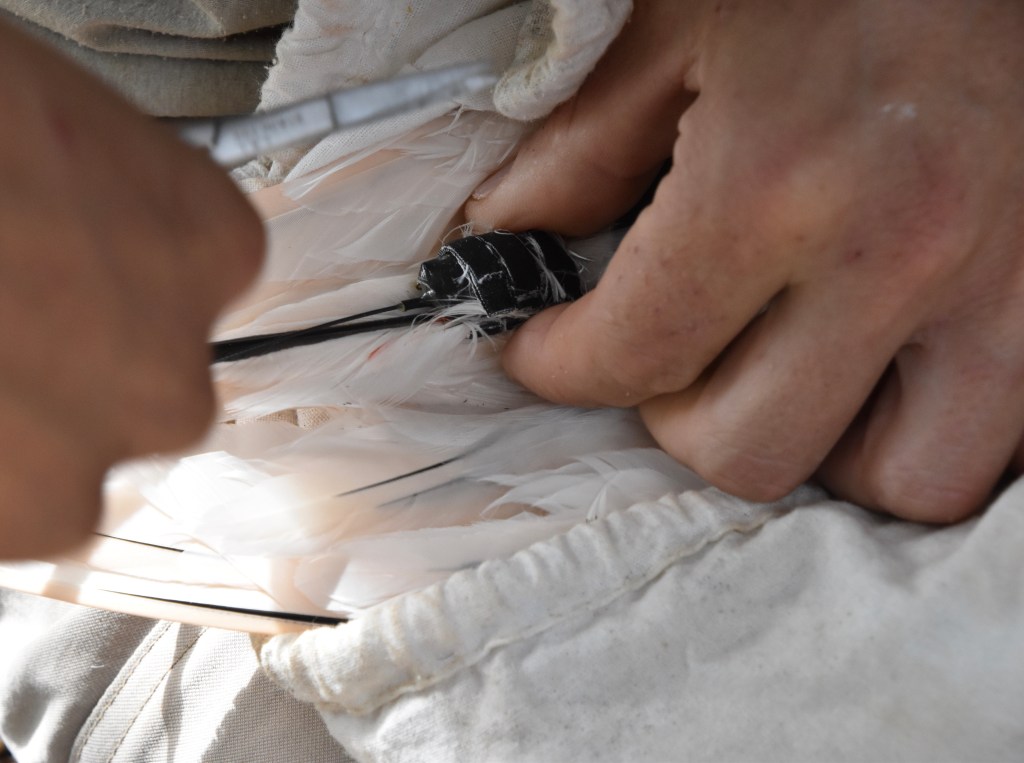
The bill of the tropicbird is formidable! Long and sharp, a jab could knock out an eye! When approached, the tropicbird lets out a loud squakk and thrusts it’s bill at the intruder. Tropicbird’s feisty demeanour is mostly bluff, I’ve learned. They need to defend their nests against mammalian predators on Norfolk Island and researchers on Phillip Island! Once, their head is covered they generally submit quietly to being measured and having transmitters attached to their tail feathers.
I think the main reason Luke doesn’t like working with the tropicbirds is that they have hippoboscid parasites in their feathers. These unusual blood-sucking flies, give “live-birth” to only one pupae (weighing more than its mother) which quickly turns into a fly and infects another tropicbird. They have a very flattened form which fits between feathers (I presume this is how they survive during immersion in the ocean) and are vectors for avian malaria. Indeed, the hippoboscid is creepy, but interesting!
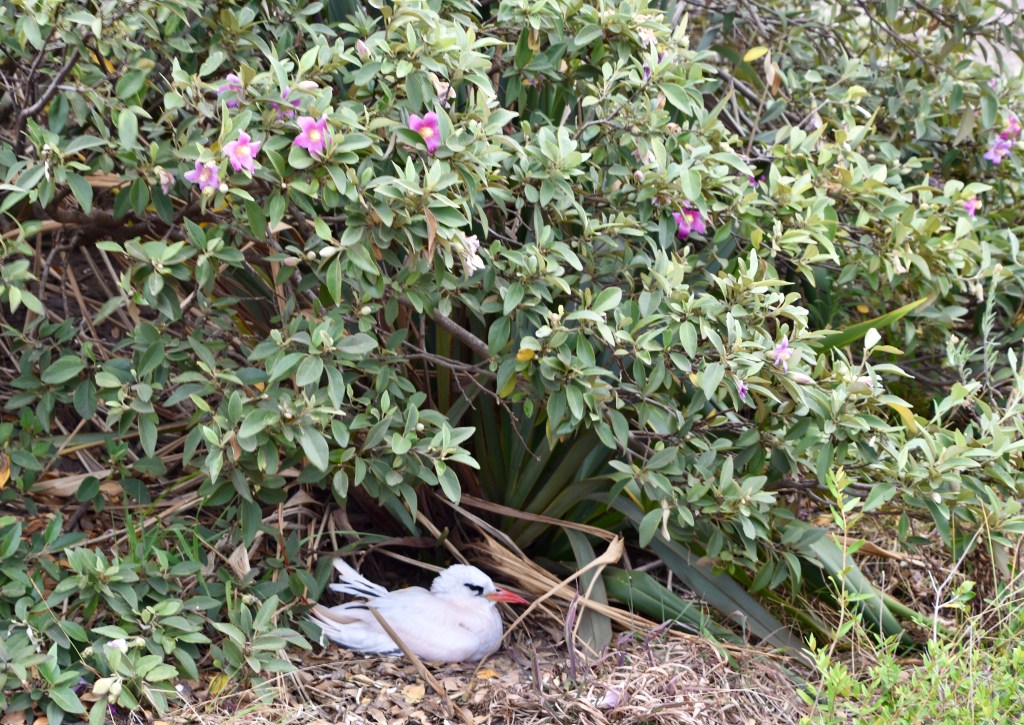
Tropicbirds have very short legs and maneuver on land by “lumping along” on their stomach, then using their strong breast muscles and largish wings to lift off! Favoured nesting locations are on cliff ledges, but we see nesting birds under the Norfolk Island hibiscus, at the edge of windswept olive scrub and even next to the cabin porch.
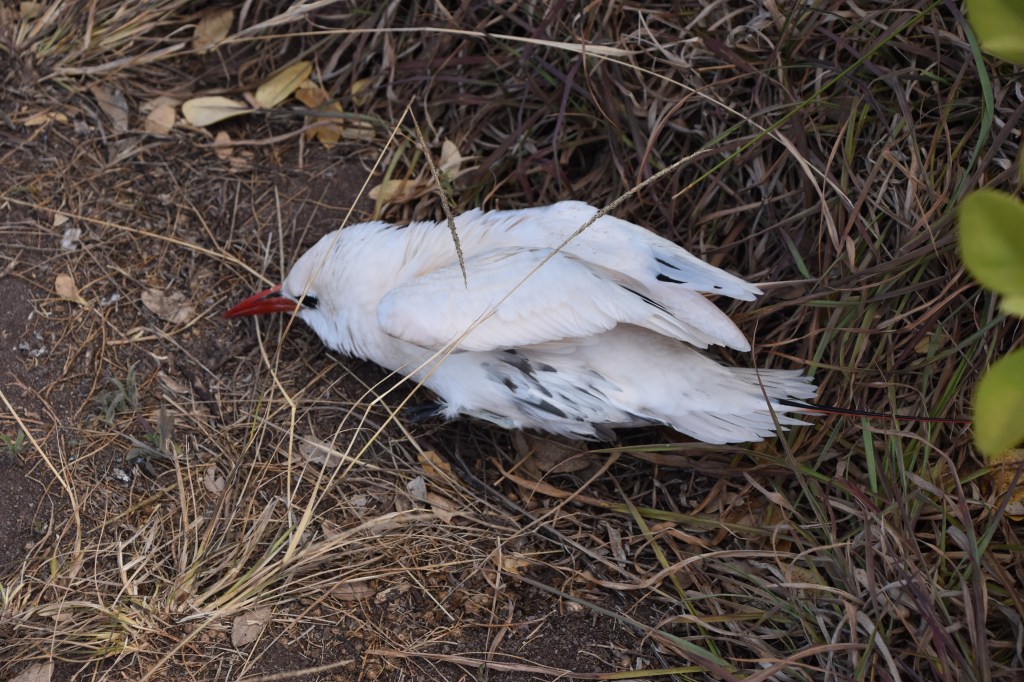
Courtship is an elaborate affair with 2 and up to 6 birds “cartwheeling or ferris-wheeling” in large sky arcs. The adults seem to take turns at the top, flapping away, then making a sudden drop downwards, while all the time calling. Some birds peel off and then pairs remain circling. Once the nest is established, it’s all business and the pair apparently doesn’t engage in cart-wheeling frivolity. Jacky Jacky at mid-day is a marvellous place to observe this behaviour.
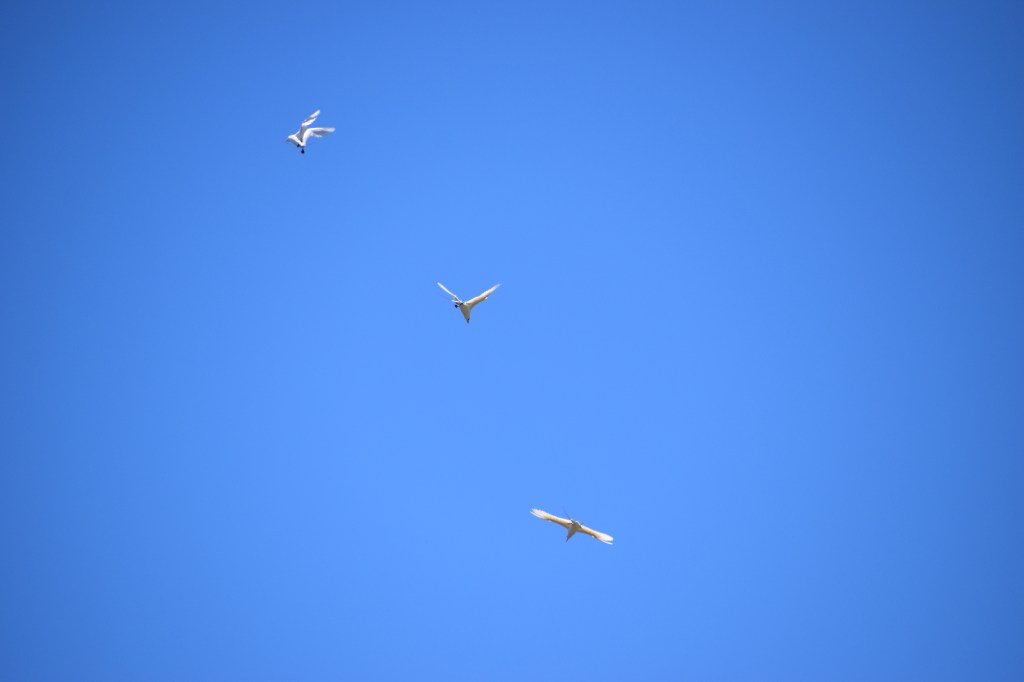
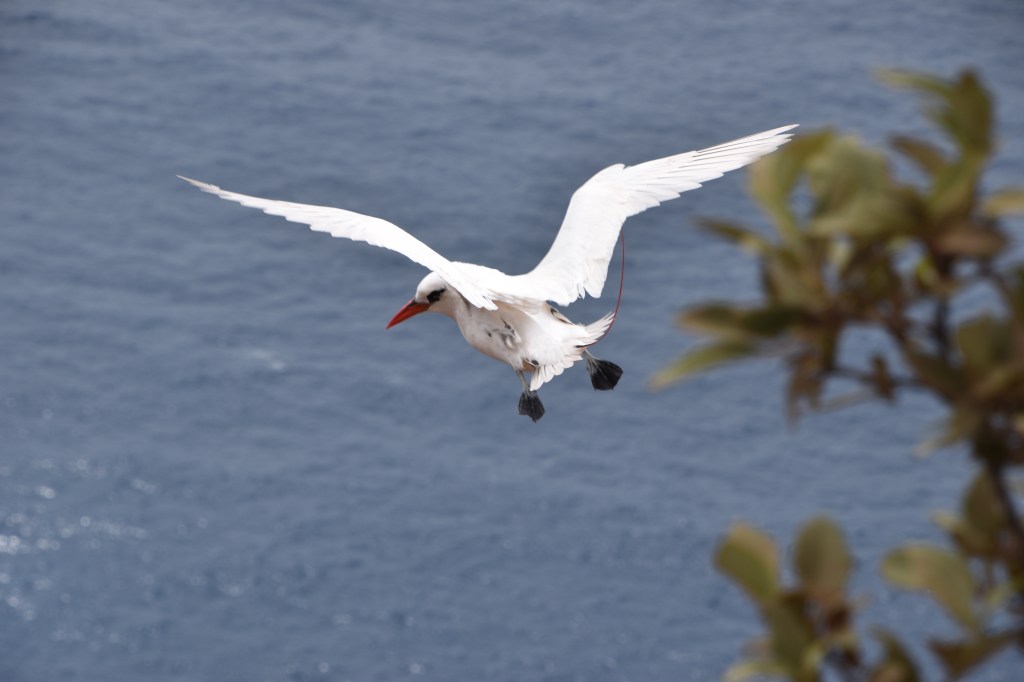
I watched a pair establishing their nest while I was waiting for another pair of adults come in. Tropicbirds are active on the colony around mid-day, so my vantage spot was in the cooling wind. The pair of tropicbirds came in and out of the nest at least 7 times during my 3.5 hour mid-day watch. They flew right over top of me. This pair was obviously a new pair as on a couple of nights we had observed a pair of Kermadec Petrels in the same nest spot. It is doubtful that this pair of tropicbirds or the Kermadec Petrels will be able to raise a chick this year. As Luke says, “It takes a long time before these seabirds get it right.”. Meaning that, these long-lived birds take several years of colony and nest attendance before being successful at raising a chick.
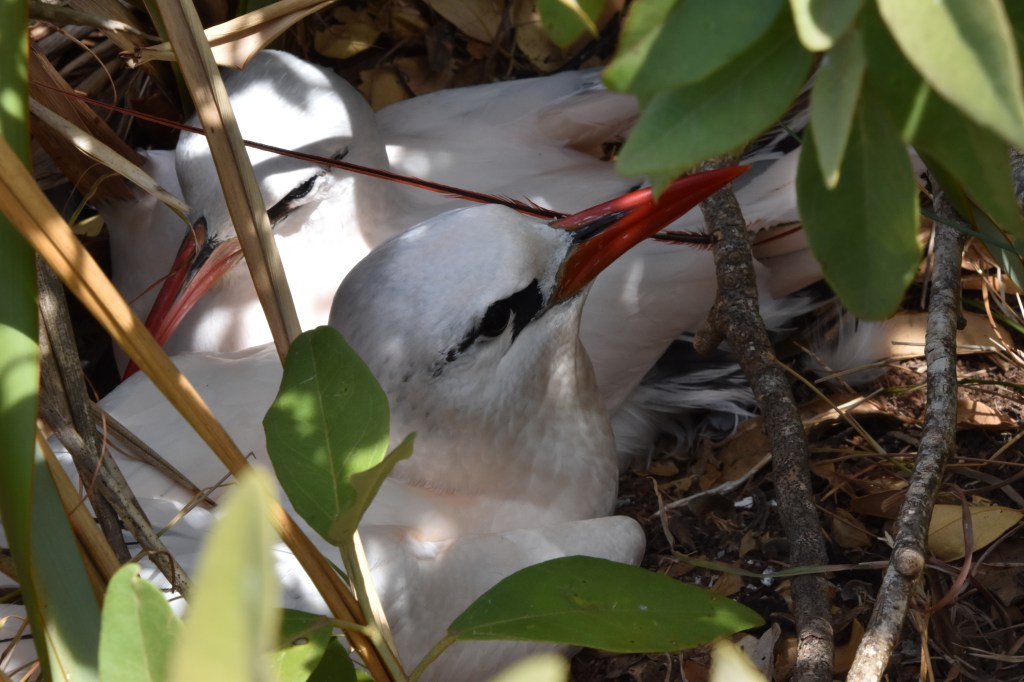
When we arrived at the beginning of January, most of the tropicbirds were sitting on their egg. Each parent takes long incubation shifts. Luke thought the cabin tropicbird was a “pretender”, as there wasn’t a tropicbird at this bush last year. However, both parents appeared on January 5th, 2020 and the female laid an egg. It seemed like the male was offering encouragement, as he left soon after. The female incubated that egg until January 17th, then the male switched incubation duties until January 26th. We left Phillip Island on February 2nd and the female was still on the nest. It is amazing to me that these active seabirds can be so still, for so long. Incubation of the egg lasts about 45 days. Tropicbirds really invest in their offspring. The chicks are feed by both parents for 61 to 97 days before the chicks fledge. I’ll be long gone, so won’t be able to see if this nest will be successful.
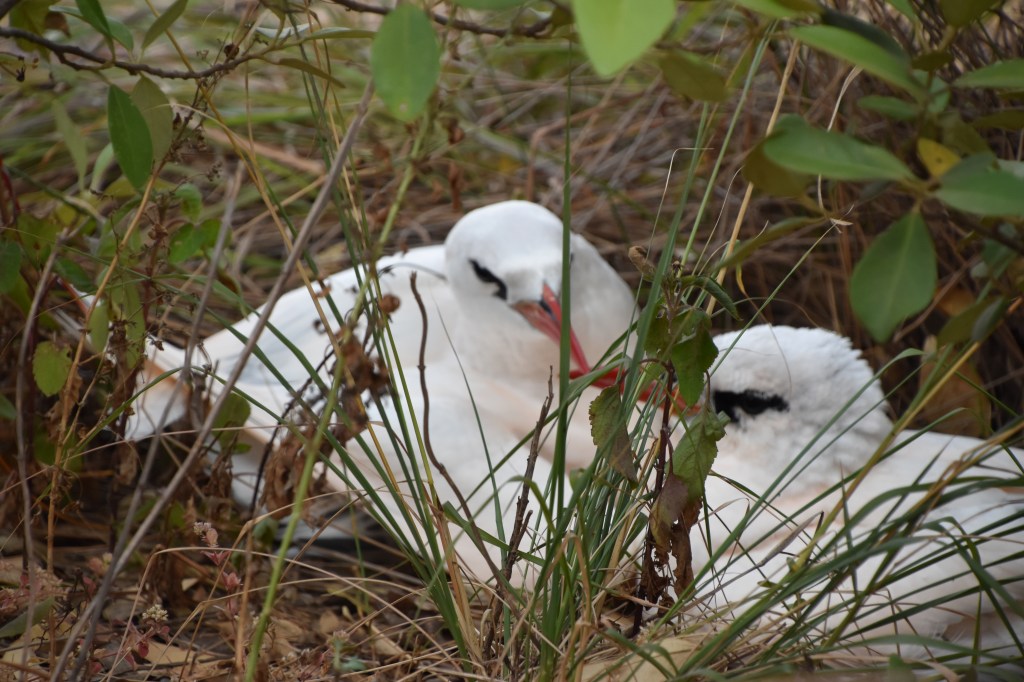
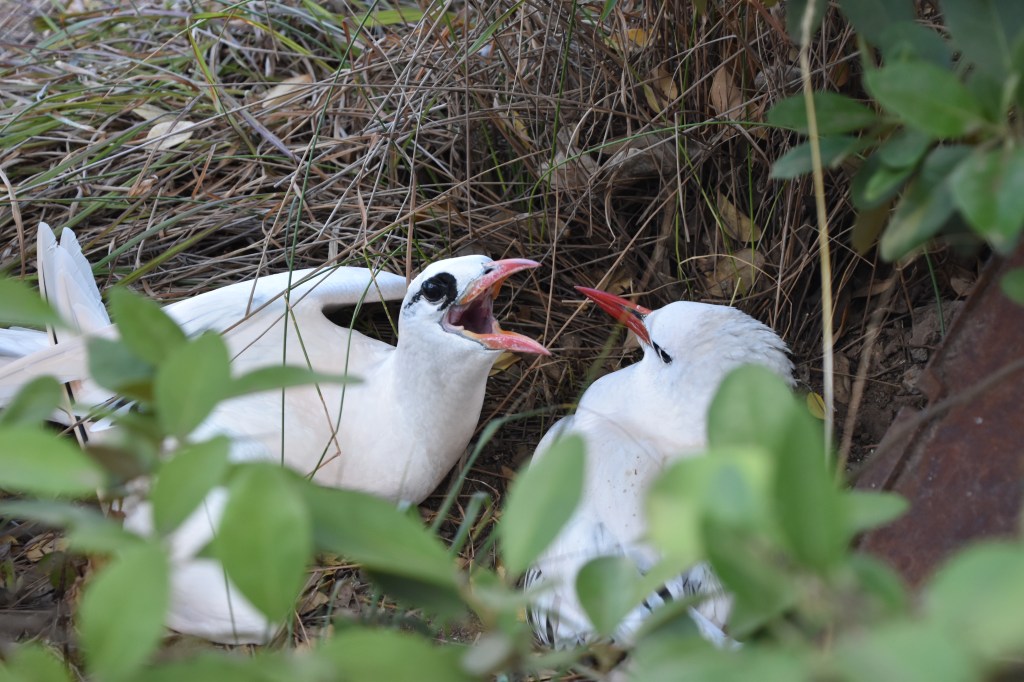
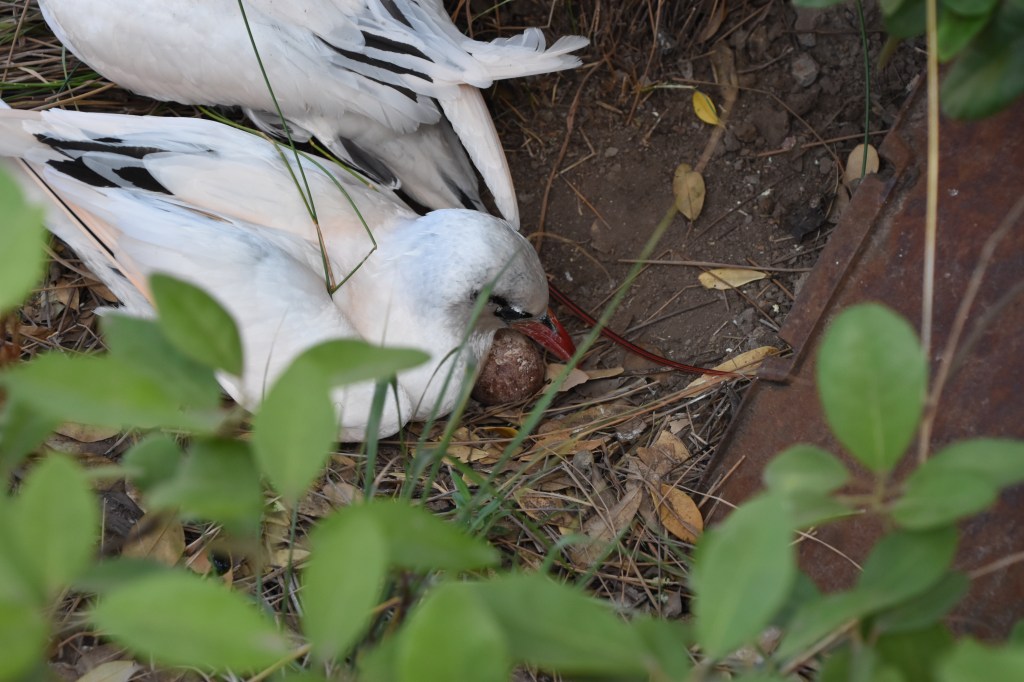
One night, I heard the gentle begging sounds of a tiny tropicbird chick coming from under a Norfolk Island hibiscus beside my tent. I thought it was a freshly hatched chick, as it was a tiny light grey fluff ball. However, since the young are born without their eyes open, it was likely about a week old. When first hatched the parents brood the chick is continually brooded and the parents prompt it to feed by stroking the base of its bill.
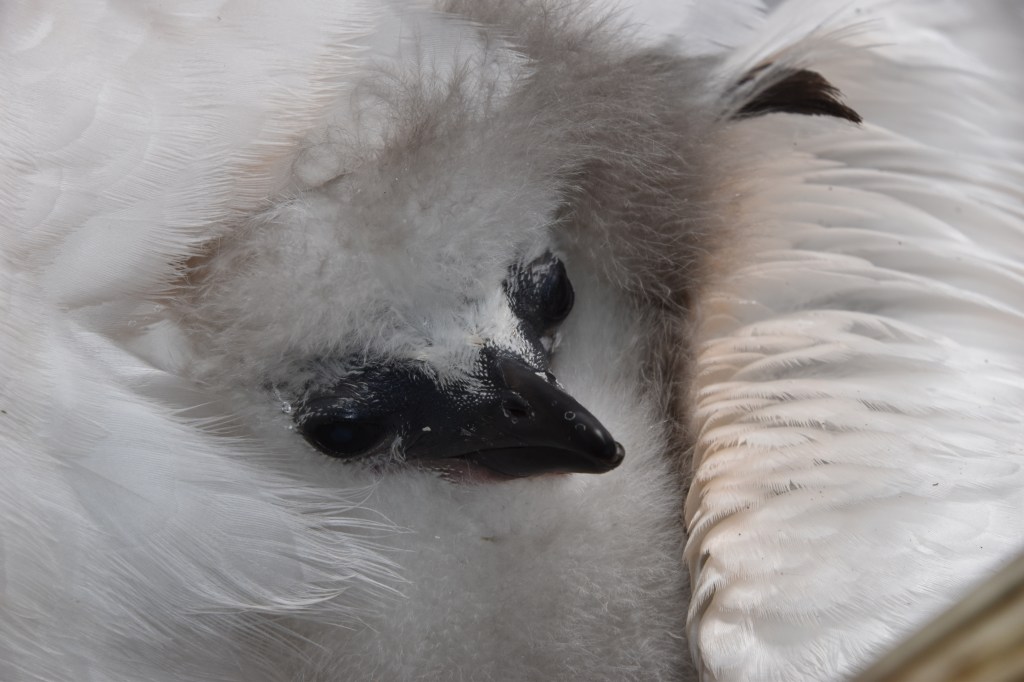
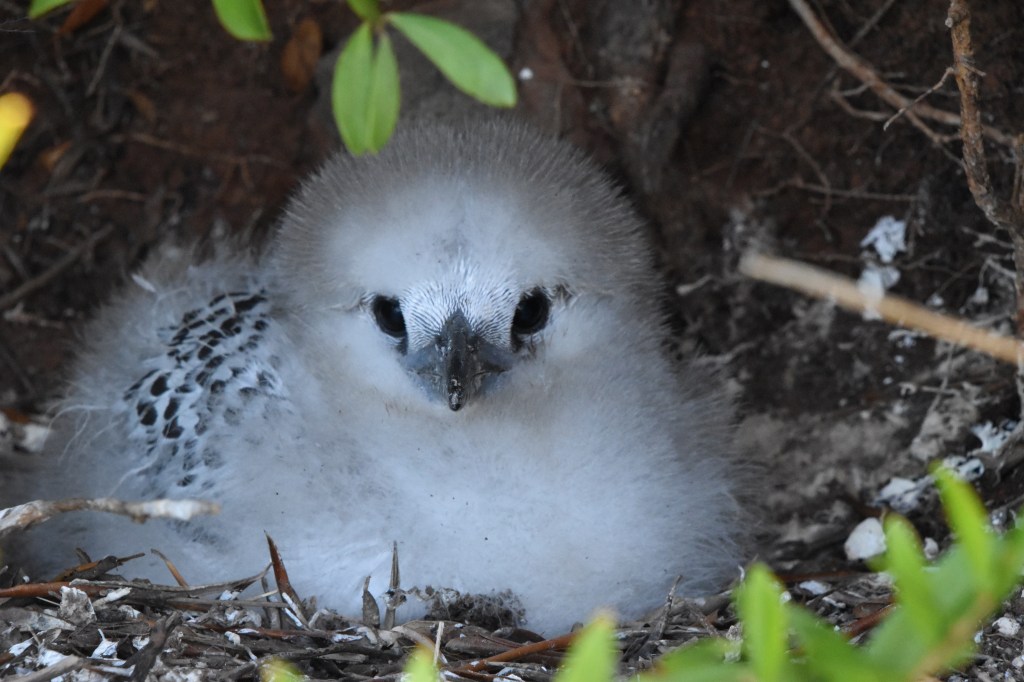
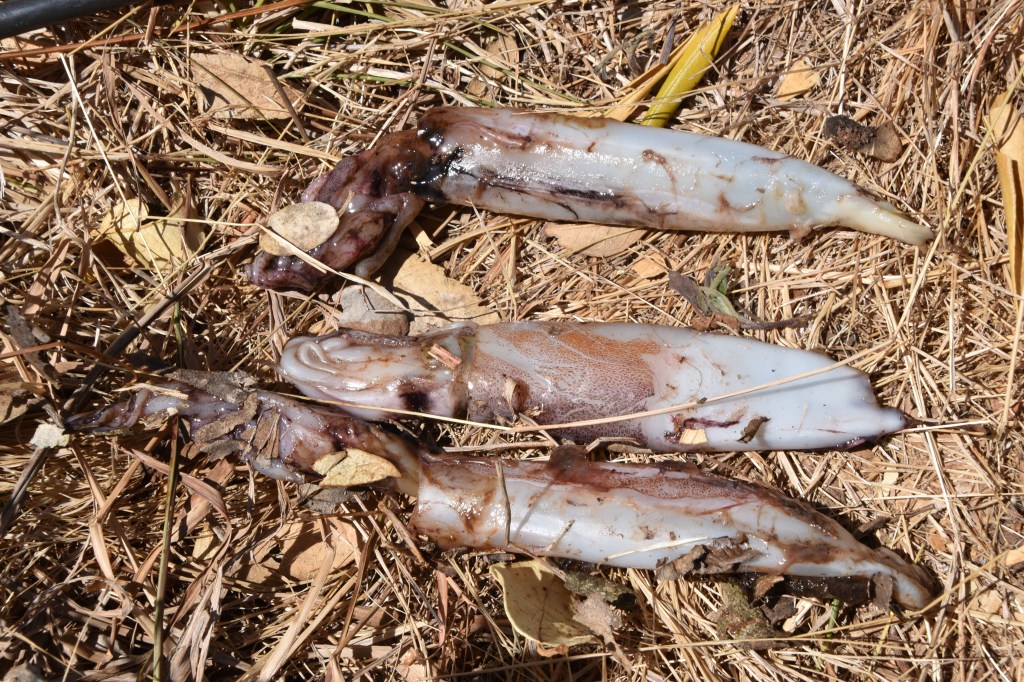
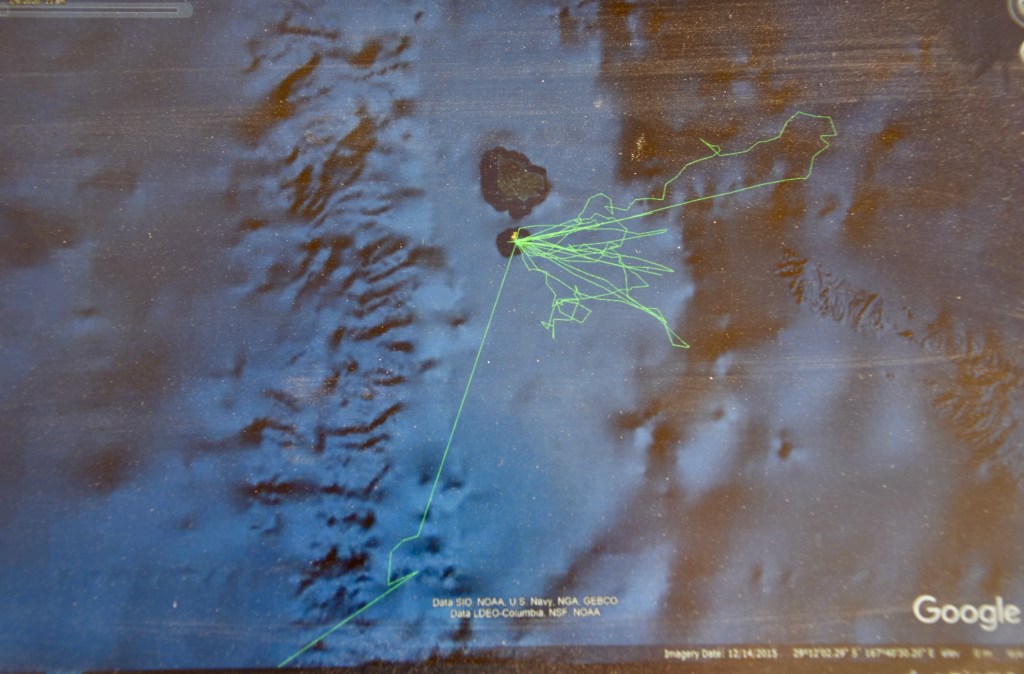
Tropicbirds are plunge-divers and can drop from up to 50 metres and submerge to 5 metres depth. Like the petrels nesting on Phillip Island, Red-tailed Tropicbirds adopt a feeding strategy that balances chick provisioning with their own sustenance. One parent goes on long foraging trips to sustain itself and the other will feed closer to the colony (where there is less food and more competition for the food) to provision for the chick. The Red-tailed Tropicbirds nesting on Phillip Island seem to mainly feed their chicks squid and quite possibly flying squid (both the glassy flying squid and the purpleback flying squid (Sthenoteuthis oualoiensis) shown below. Tropicbirds also feed on Flying fish (Exocoetus volans) which can be seen on the boat trip between Norfolk and Phillip Island.

This season, Luke put GPS loggers on 7 Red-tailed Tropicbirds with chicks. This meant “staking out” tropicbird nests during the mid-day period when there was the most tropicbird feeding activity. Raucous as tropicbirds are around the breeding colony, the adults seem to drop into the nest pretty silently, so one had to keep a close eye. Luke was able to re-capture the adults with tiny chicks pretty easily as parents came back to feed regularly. However, even after he had re-captured all the Kermadec Petrels there was a couple of “holdouts” up near Owen’s camp. I took on waiting these birds out . . . I must admit that at first, I was pretty intimidated by the tropicbirds which I had seen Luke practically wrestling for. They protested so loudly and were very strong with their beaks! So it was through quite a bit of self-talk that I took on the capture. “Listen, you can handle horses and angry bats!” “Just remember that time you leapt on that vicious dog that nearly had Cecil and T-dog in its jaws!”. So the first time I approached quietly in a face-off with the bird. The little chick was anxious for a feed and also squacked and begged. Occasionally, it would jab at the adult to gets its attention. When the adult turned to attend to the chick, I made the move! A lot of squawking! I had the bird bag over my hand and my handkerchief in pocket. Once the bird was in my lap, with its head covered and long wings semi-folded in, I tried to radio Luke! It was lot to manage. “Got the bird, GPS too”. The radio fell out of my hand as Luke was relaying instructions. “Take the bird to Owen’s camp!”. I was on my way with the tropicbird and was glad of the shade and cool.
With the bird head safely covered I knew that I had to calm the bird (and myself) to wait for Luke to come up the hill. I loosened my grip on the strong bird and just sat quietly with the bird on my lap. Luke arrived quickly, dripping with sweat. He detached the transmitter, weighed the bird and then instructed me to return the bird to its nest. The slightly dishevelled adult went back to its chick without incident. I swear that the little chick recognizes me as an evil interloper!
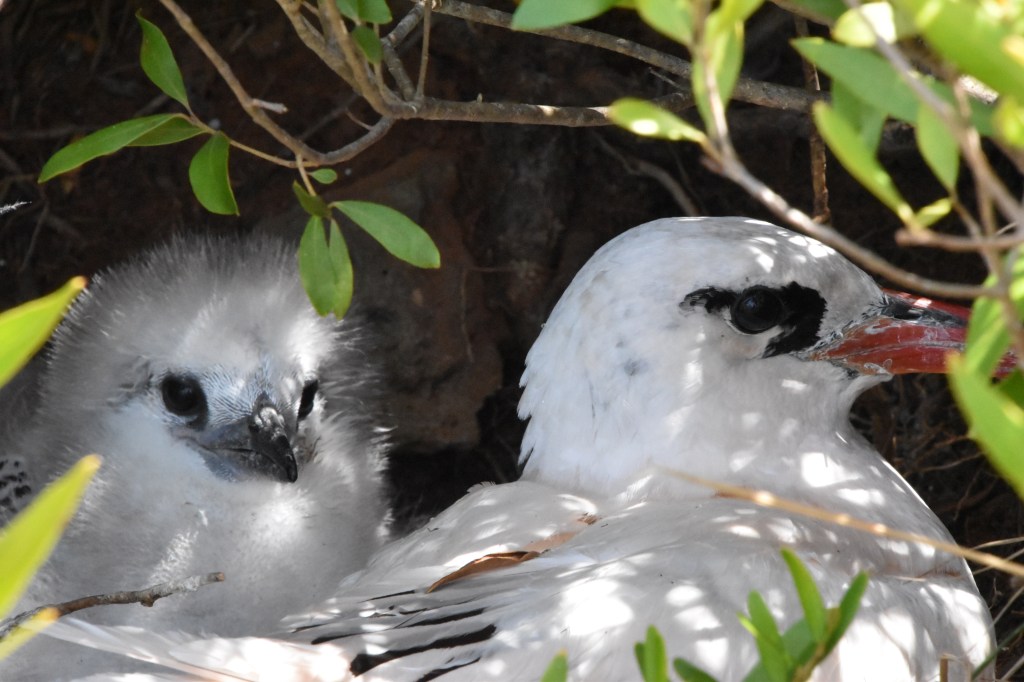
The Red-tailed Tropicbird is considered to be Least Concern worldwide as it is widely distributed throughout the Indian and tropical Pacific Ocean. However, Red-tailed Tropicbird (ssp. roseotincta) is considered to be Vulnerable in Australia as there were only about 381 nesting pairs in 1995 (Coyne, 2014). Other than Phillip Island, it nests on Lord Howe Island, Northeast Caye, Southwest Caye, Raine Island and Norfolk Island. Phillip Island is very important to the population of nesting Tropicbirds especially since dogs, cats and rats threaten many of the other populations. We recently heard of a dog on Norfolk Island that grabbed a tropicbird adult and injured its wing on Norfolk Island.
Phillip Island has a long history of human association with tropicbirds. In the 1790-91 breeding season, six marines and convicts took 430 Red-tailed Tropicbirds (for plumes and eating I presume) over 14 days! In the early 1970’s, there was only about 100 pairs of tropicbirds nesting on Phillip Island and Priddell and Nicholas Carlile estimated fewer than 100 nests in 2006. Judging from the numbers of tropicbirds flying around Jacky Jacky at mid-day, it appears that Red-tailed Tropicbirds are increasing on Phillip Island. It is my hope that future generations will be witnessing these magnificent birds cartwheeling beside cliffs and raising their chicks in peace!

 Trudy’s Pacific Adventures
Beautiful birds and I can see why you like the chicks!
LikeLike